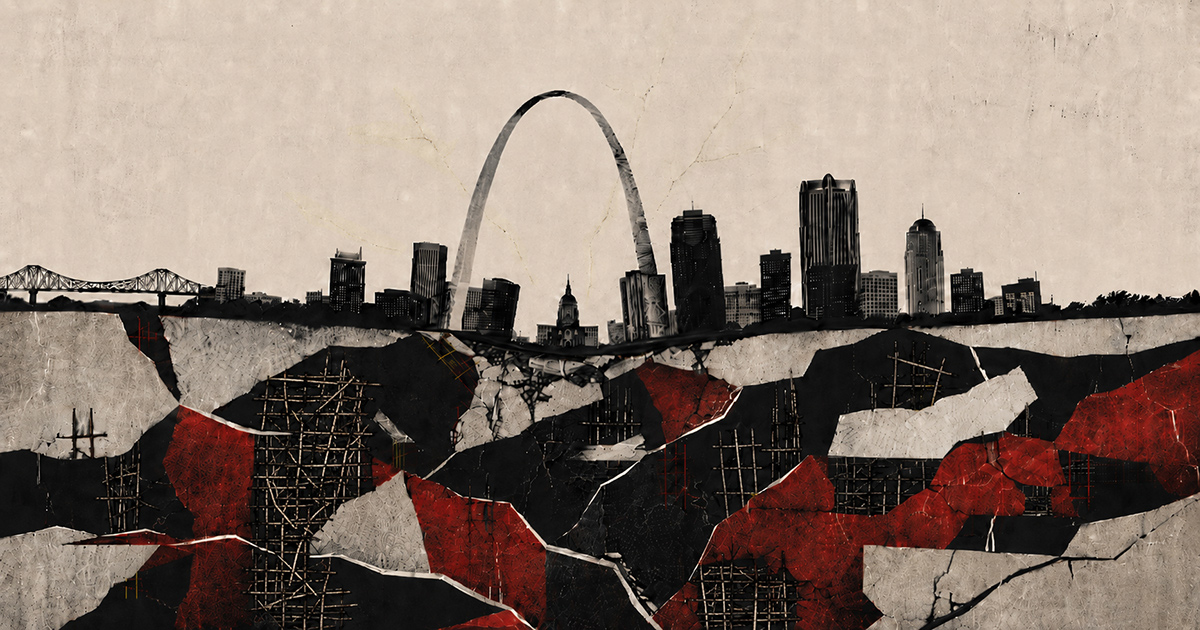
When a massive sinkhole opened in the heart of downtown St. Louis, it seemed to happen almost without warning. Streets closed. Traffic was disrupted for days. Repairs would be neither quick nor inexpensive.
But the collapse itself wasn’t the real story.
The massive cave-in was caused by the failure of multiple century-old water mains. As they ruptured, water gradually washed away the soil beneath the street until the surface could no longer support itself. What appeared to be a sudden disaster was actually the result of years of hidden deterioration beneath the surface.
A sinkhole doesn’t appear overnight. It forms through erosion that often goes unseen. By the time the collapse becomes visible, the damage has already been done.
That is a powerful metaphor for the St. Louis region.
For years, we have quietly lost population, national relevance, and many of our best and brightest people. I won’t belabor the statistics or revisit the familiar narratives that often dominate conversations about our region. We know them well enough.
What matters is what they represent.
Like the sinkhole, these aren’t isolated events. They are symptoms of something deeper. They reveal an erosion that has been occurring beneath the surface for years—an erosion of our human capital, our economic strength, our physical infrastructure, and, perhaps most importantly, our ability to act together as one region.
No part of a region remains healthy forever if the foundations around it continue to erode.
Too often, we treat our challenges as though they exist independently. We debate schools separately from housing, economic development separately from public health, downtown separately from our neighborhoods, infrastructure separately from workforce development. Yet communities do not work that way. Everything is connected.
When we fail to address these interconnected challenges together, the erosion doesn’t stop. It spreads. Problems that once seemed isolated gradually become regional. What appears stable on the surface may already be weakening underneath.
The good news is that erosion can be stopped. More importantly, a strong foundation can be rebuilt. But doing so will require us to think and act differently.
First and foremost, we need a regional North Star—a shared vision that unites us around the future we want to create. It must be larger than any one municipality, institution, organization, or political agenda. It should challenge us to work together in ways we never have before.
That will require uncomfortable conversations. It will require listening to perspectives different from our own. It will require acknowledging that continuing to operate within the same structures and habits that brought us here will not produce a different outcome. Most of all, it will require leadership willing to think beyond the next election and make difficult decisions for the long-term health of the region.
Second, we must better align the incredible work already happening throughout St. Louis.
Our region is not lacking generous people, strong organizations, innovative ideas, or committed leaders. What we often lack is alignment. Too many efforts remain disconnected, pursuing similar goals without the scale or coordination necessary to create transformational change.
We should be creating incentives for greater collaboration, directing resources toward shared priorities, and measuring success not by isolated accomplishments but by meaningful regional outcomes.
Finally, we must invest boldly in the people and places that have been left behind for far too long.
People are every region’s greatest asset. Yet we have failed to fully invest in the potential of too many of our neighbors. In doing so, we have limited not only their opportunities but our collective future.
This also requires recognizing a fundamental truth: there is no housing solution by itself. There is no education solution by itself. There is no jobs solution, health care solution, or economic development solution by itself.
Communities are systems. Their challenges—and their successes—are interconnected. Lasting progress only comes when we strengthen those systems together.
Does all of this sound overwhelming? Perhaps.
But what choice do we have? As the saying goes, if not now, when? If not us, who?
Engineers don’t repair a sinkhole by paving over the hole. They stabilize the foundation beneath it.
Regions aren’t any different.
The lesson isn’t simply that sinkholes happen. It’s that what happens beneath the surface eventually determines what happens above it.
If we have the courage to strengthen our foundation together, St. Louis can become everything it has the potential to be.