
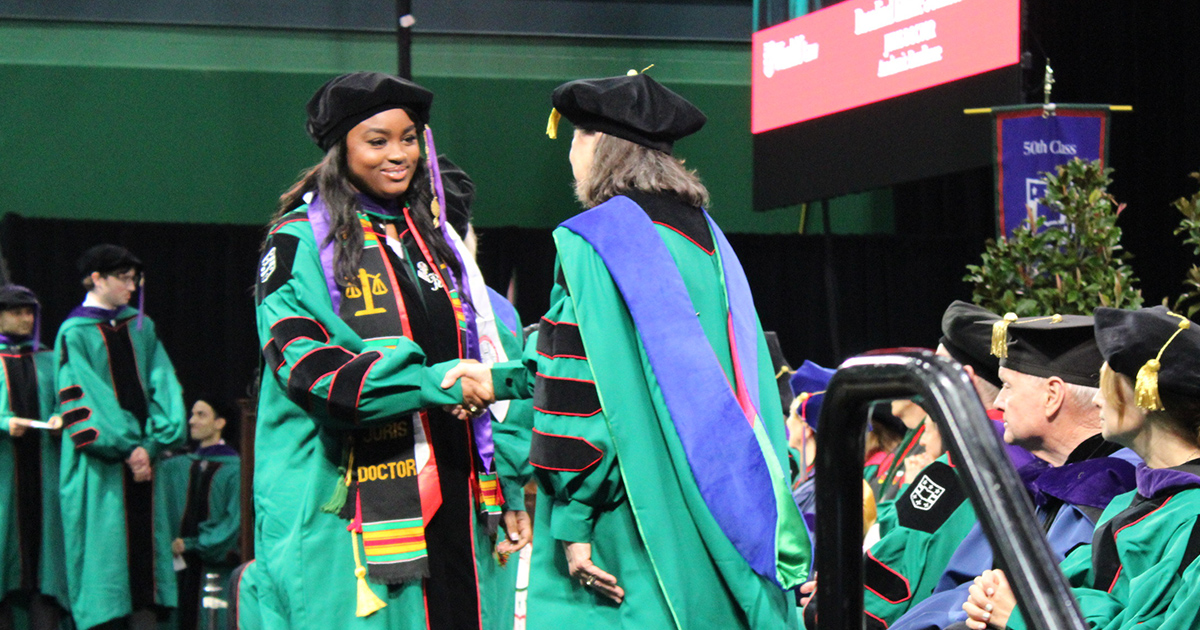
Rosalind Johnston has always wanted to be a lawyer. It was her goal even as a child, before she knew the challenges of entering the legal profession. And later this fall, the Washington University Law School graduate will embark on her legal career at a full-time job with a law firm in Houston.
While growing up in North St. Louis County, Johnston made her mark as a top-10 student at Ritenour High School. A college counselor suggested she apply for Beyond Housing’s College Savings Program, also known as Viking Advantage. Because she worked from age 16 on, Johnston steadily added to her account—and those contributions were matched 3-to-1 by Beyond Housing.
Johnston’s law degree is another win for Viking Advantage, which has produced nearly 150 college graduates, including 18 master’s degrees and one medical degree. The program helps high schoolers save for higher education and also mentors them through the process of campus visits, financial aid, college applications, scholarships, and more. Participants must live in the 24:1 Community, although they do not need to attend Normandy schools.
Johnston was accepted to Washington University on a full-ride scholarship. “They covered the tuition and fees, but I still had to figure out how to pay for books and electronics and things like that,” she said. During her first semester, she purchased a laptop for classwork using the savings account. Another term, she bought books.
After Washington University changed its scholarship program to cover all expenses for low-income students, Johnston didn’t need to tap into her savings. She also benefitted from TRIO Student Support Services, a U.S. Department of Education program that helps students who are low-income, first-generation, or disabled successfully transition into college life. “They were a big support. They helped source books and things like that,” Johnston said.
“When I got done with undergrad, I hadn’t used the account to its full potential,” she said. James Moyamba, Beyond Housing’s College Access Program Manager, reassured her that the funds would also be available in graduate school. She had intended to apply to law schools across the country, but after receiving an offer she couldn’t turn down from Washington University in July of her junior year, she committed to attend—without even having to take the LSAT.
Johnston was grateful to have the savings account for books and other essentials during law school, and when she graduated in May, she did not have the specter of student loans to influence her job decision.
Sharing her experiences as a mentor
Because Johnston did so well during her first year of law school, her fellow students approached her for everything from outlines to advice on building relationships with professors. She also guided incoming students on the application and interviewing process.
“I was the academic chair for the Black Law Students Association,” Johnston said. As a board member, she mentored other students based on her own law school journey.
For example, she encouraged them to start thinking about the LSAT early, in case they needed to take it multiple times to get their desired score. Other timelines are also very important, like the legal job market application process, which starts in the fall of first year for first summer placements and the spring of first year for second summer placements. If the university’s career center is not up to speed, students risk missing out on opportunities.
Johnston also suggested in-depth research on law schools. “Determining what law school to go to based on where you want to end up is very important,” she said. While rankings matter, so does placement. Saint Louis University graduates often go on to jobs in Missouri and the greater St. Louis region, while Washington University graduates are more likely to find national placements, she explained.
This was a key factor for Johnston, who is delighted to be moving to Houston to work at Sidley Austin LLP, which specializes in energy, corporate law, and complex litigation. “I’ve been in St. Louis all my life. I want to leave and spread my wings away from everything I’m used to for a while,” she said.
Another consideration was finding an environment where she could continue to grow and learn as a young lawyer. At her new firm, she said, “for about two years we get to try everything to see what we like.” Because she spent two summers working with Sidley Austin, she has already experienced many aspects of its work, including mergers and acquisitions, global finance, aviation, project finance, and bankruptcy.
She urges other law students to be OK with uncertainty around their practice area. “Don’t feel like you have to know what you want to do,” she said. “Trying a little of everything helps since this is something you’ll be doing long-term.”
A final piece of advice is about debt. “Don’t have the misconception that regardless of your practice area, you’ll come out making a ton of money,” she cautioned. “Some passions, like public service, do not pay well. Taking out a lot of debt could force you into a certain bubble that you might not want to be in.”
This savvy alum of Beyond Housing’s College Access Program will be an excellent resource for future law students. But in the short term, after taking her bar exams over the summer, Johnston departed for a much-needed vacation to South Africa with two friends. She will receive her exam results in October and start work as a lawyer in November.